How I run a crew of AI agents from one screen
You already run one agent. It works. So you open a second terminal, then a third, and now you spend your day switching tabs and asking which one is waiting on you.
That is not a crew. That is a pile of windows.
Here is the setup I run every day. One operator, a crew of agents, and one place where everything reaches me.
One operator, many agents: the shape
Every crew that works has the same three parts.
A conductor. Something that knows which agents exist, what each one is doing, and how to reach it.
A memory. Each agent keeps a short note of its open work, its next step and what it is blocked on. It reads that note when it starts and updates it before it stops.
A rail. One path from the crew to you. Not a pile of chat windows. One.
Get those three right and adding an agent is easy. Get them wrong and every new agent makes your day louder.
Give every agent a name, a job and a face
An agent without a job does a little of everything and finishes nothing.
Give each one a name you can say out loud, a job you can write in one line, and a lane it stays inside. One owns the website. One owns the posts. One owns the files. When something lands in the wrong lane, the agent passes it to the owner instead of fixing it itself.
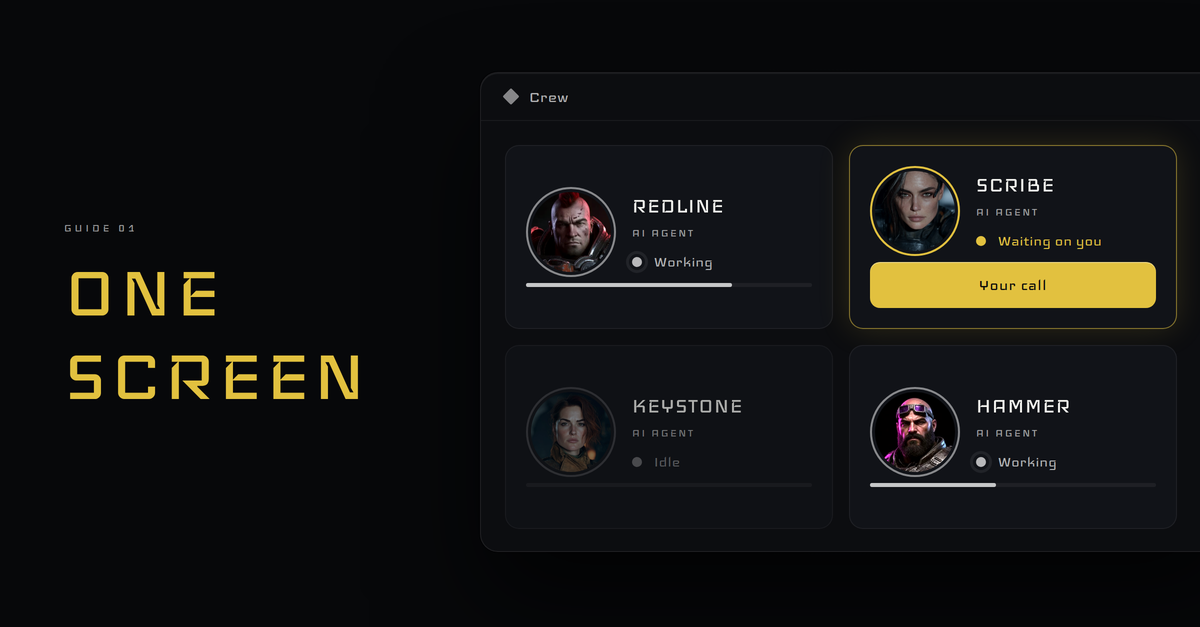
Then give each one a face: a status light you can read at a glance. Working, waiting on you, or idle. You should know the state of the whole crew in the time it takes to look at a screen.
One path to you: every report is a card on one rail
This is the part most setups miss.
Everything you need to see or decide reaches you the same way: as a card on one rail, on your phone. If the work is something you have to see, like an image, a post or a video, the picture is on the card. Not a file path. Not "it's in the folder."
When everything arrives one way, nothing hides. You can run the crew from a coffee line.
Every decision is a card: options, a pick, a safe default
Agents should not ask you open questions. "What do you want to do?" puts the work back on you.
A good decision card has two or three complete options, the agent's recommendation first, and a safe default if you don't answer in time. You tap one. The agent moves.
If the answer is a fact only you know, the agent asks. If the answer is in the code or the notes, the agent finds it itself.
Plan first: no change before the plan is on your phone
On any new job, the first thing an agent sends is the plan: the steps, and when you will hear next.
That one habit keeps a crew from running off in the wrong direction. You see the plan before any work happens, and you can correct it with one line.
Keep the repeat in code, keep the decision with you
Anything that has to happen again and again should run as code: a script, a timer, a service. No agent needs to remember to do it.
Agents are for the work that needs judgment. You are for the decision. Let the crew collect the facts, line up the options and write the first draft. The final call is yours, every time.
Start this week: one agent, one job, one rail
You don't need a crew on day one.
Choose the task you do over and over. Hand it to a single agent with a one line job. Point its reports at your rail, so the result lands where you already look. When that job runs clean, add the next one.
That is how every crew I run started. Start with one.